|
| As one opposing coach said, “Joey Flannery won games. He’s a winner." Photo by d3photography.com |
By Ryan Scott
D3hoops.com
You might not realize it yet, but Joey Flannery holds the mythic position in Division III basketball that Michael Jordan does for the NBA. That may sound like hyperbole, but as you investigate his career and talk to the people who know him best, the analogy is impossible to ignore. Flannery’s induction into the Small College Basketball Hall of Fame this fall is a recognition of this legendary status that transcends traditional measures of greatness.
Joey Flannery is not unquestionably the best Division III player of all time, but when it comes to what makes him and Jordan special, both possess an innate, intangible greatness; a will to win; a competitive drive; and an ability to elevate the team that makes an impression outside their considerable individual achievements.
Flannery did score 2,620 points in his four years at Babson. He shared or won outright the NEWMAC Player of the Year award four times. He was a three time First-Team D3hoops.com All-American, a First-Team All-Decade honoree, and missed out on National Rookie of the Year only to Duncan Robinson.
As with Jordan, Flannery’s greatness exists beyond statistics. He possessed (and still does) a relentless will to win, a charisma that elevates everyone around him to greater heights than they thought possible, and a determination to never settle for anything less than immortality.
Matt Droney, Flannery’s Babson teammate and roommate at the Taft School in Connecticut, where Flannery did a post-graduate year (and shared State Class B Co-Player of the Year honors with All-NBA guard Donovan Mitchell) puts it this way.
“We had all these scholarship guys, players with lots of big schools looking at them, myself included at the time, and I went into coach’s office the very first day of practice and said, ‘Joey’s the best player on this team, by far, we’re only going to go as far as he can take us.’”
Flannery’s brilliance, though — his foot-work and vision for the game, his deceptive quickness and positioning — has to be seen in person to be truly believed. And his greatest attributes, that intangible work ethic, motor, and relentlessness, those require a look behind the scenes.
“His three point percentage wasn’t ideal,” notes Babson head coach Stephen Brennan, struggling to find reasons why Flannery wasn’t pursued by scholarship programs. “He genuinely just wants to help the team win, so he wasn’t chasing numbers like a lot of prep school kids.”
“I didn’t have that feedback that some of the kids get nowadays,” says Flannery. “I was just straight up told I wasn’t good enough.”
Flannery’s unlikely rise to basketball star started in Acton, Massachusetts where he grew up playing hockey.
“Some of my family members were questioning why I was getting away from hockey, my Dad being one of them,” remembers Flannery, “but he was one of those family members storming the court on our Final Four runs. I’m thankful that so many [family members] were able to be at all the games.”
‘We’ is littered through Flannery’s words about himself. Players are taught to elevate teammates and coaches over acknowledging their own accomplishments, but Flannery’s success is inseparable from that of his family or his teammates. He was the catalyst, the engine that made the machine run — without him the wins wouldn’t have been possible — but it’s quite easy to believe the opposite is true as well. As good as he was, the team was equally essential.
It’s probably why Flannery has had such great success as a coach as well. After one year of pro ball in Spain, he garnered a coveted spot on the Villanova bench as a Graduate Assistant under Naismith Hall of Fame coach Jay Wright.
The two-time Division I national champion is effusive in his praise.
“He has such a high basketball IQ, a high emotional IQ. He knows the game and he knows how to teach the game,” Wright says. “It’s easy for great players to be frustrated when teammates can’t perform to their level, but Joey had such compassion… and that’s not to take away from how talented he is as a basketball player!”
Brennan remembers when this first came to light. “Early in his freshman year we played at Tufts, this thing called the Big 4, Salem State and Brandeis. Joey scored 30 in both games [31 and 30, respectively, shooting 21-26 from the floor] and he came into my office early Monday morning asking what he could do better to help the team win. He was that kind of player.”
While Joey was who he was from the start, his game evolved over four years. A post game showed up during sophomore year. He essentially played point guard as a junior, adding a mid-range game. By senior year he was a threat from deep (38%) and had mastered the high post.
“I’ve never, ever seen anybody work as hard as Joe,” says Droney. “Most guys get up shots over the summer, they lift, maybe play some pickup. Joe was working out three, four, five times a day, every day, all year round.”
Adds Brennan, “He never wanted to let his teammates down and it rubbed off on them. They saw how hard he was working and put in their own effort. I’ve never seen a team so close. They never talked about any numbers, just wins, and that was because of Joey.”
To the national semifinals and back again
| Joey Flannery was defined as much by his relentlless will to win as by his many career accolades. Photo by d3photography.com |

Flannery, typically, gives credit to other players for his development. “I had older guys — juniors and seniors, some of them I’m great friends with, David Mack in particular — who pulled me aside and said ‘you’re going to do X, Y, Z — you can — so just start doing it,’ I had a senior point guard, Kenny Ross, who made things really easy for me. I was able to play basketball and not worry about stuff in the locker room, the leadership.”
Sophomore year saw Flannery flourish. Babson was 29-3 overall. One loss in conference, one out. Flannery scored 13 of the final 15 to knock off a stacked Johns Hopkins team 49-47 and then rallied past Trinity (Conn.) 76-69 in overtime to advance to the national semifinals, before hitting a brick wall in perennial national power Augustana.
“We got outplayed,” recalls Droney, of the 68-48 loss. “In retrospect, we were wet behind the ears and just happy to be there. We did see what it took to be a championship team, though — we knew we could do it, but we’d have to step it up a notch.”
Flannery had a stellar game. He scored 27 points, but, more importantly, as Brennan noted, Flannery learned he could not carry the team alone.
In his junior year, Babson didn’t realize the promise of the previous season. 23-6 is nothing to sneeze at, but it wasn’t what Flannery and company knew they were capable of. A loss to Tufts in the Big 4, followed by a double-overtime home defeat to Amherst, where Flannery’s 8-26 shooting was not his typically reliable efficiency.
The ship was righted during conference play and just when Babson seemed poised to put another March run together, Flannery, who’d been dealing with nagging injuries all year, couldn’t finish the rematch with Amherst.
“His pain tolerance was super-human,” says Brennan. “There would be lots of times when he couldn’t practice all week, then come in for the game and score 30. He never wanted to let his brothers, his teammates down.”
“When we got into the locker room after that game,” remembers Droney, “Coach B hadn’t even come in yet. We rising seniors just looked at each other and said, ‘we’re winning the national championship next year, here’s how, and it starts now.’”
Fitness has always been the foundation for Flannery’s game — between the hockey conditioning and the hits, he knew how to absorb punishment and push through. So many offensive players need to borrow time on the defensive end or on the bench to provide what the team needs on offense. Flannery played all out, every minute, on both sides of the floor. That was ratcheted up senior year.
If that season had not ended in a title, the highlight of the Babson year might have been a loss, in double overtime, again, to Amherst.
Droney again, “[Amherst guard] Johnny McCarthy was an awesome defender. Of all the kids I watched guard Joe, I felt like Johnny always did a great job. [That night] it made no difference, because Joe was making shots from everywhere with a very high degree of difficulty.”
Flannery played all 50 minutes and scored 41. McCarthy nailed a three to tie it, then Flannery missed a go ahead layup with 28 seconds to go. The Babson faithful insist he was fouled. Amherst scored at the other end. It’s still a tough memory for everyone on the losing side.
Watching on stream, it remains the highest level regular season game in my memory, and a catalyst for the high level of play required to fulfill the seniors’ mission.
“It revealed you had to play at another level to win against an elite team,” notes Brennan, when pushed, still reluctant to give Amherst any credit for Babson’s success. “You have to make shots, but it’s making plays, making less mistakes, winning the 50/50 balls, and the offensive rebounds that get you a possession.”
Babson needed every last inch and bead of sweat they could muster for the March gauntlet that lay ahead, starting with Husson and All-American Raheem Anderson. Then, the Beavers battled past Skidmore, Tufts, and Keene State, and reached another Division III final four.
The only place the Jordan comparison breaks down is that Flannery is not flashy. You’re often surprised to see the box score at the end of the game. Still, he was a rocket ship, oozing talent and excellence, and absolutely the driving force for everything Babson accomplished during his four years there. His chief contribution, however, was dedication to the whole, to making his teammates believe winning was possible, and inspiring them to raise their games to the level required for greatness.
There have been countless great performances in the Division III tournament: Horace Jenkins. Michael Nogelo. Jeff Gibbs. Aston Francis. Joey Flannery simply did not stand out like those guys (at least not until the very last moment, but we’ll get to that). He just won games.
“So many guys can score,” notes Eric Bridgeland, current Redlands and former Whitman head coach. “Joey Flannery won games. He’s a winner. Not as many guys can do that.”
The first half of the 2017 National Semifinal between Babson and Whitman is the highest level basketball I’ve ever seen two Division III teams play. Bridgeland had a near perfect roster to run his chaotic style of ball pressure and fast breaks. They swamped Babson, and the Beavers trailed Whitman by 25 at the under-eight-minute timeout in the first half.
Memories about the exact quote vary widely among the participants, but everyone agreed it was Charlie Rice who said something to the effect of “now or never.” An outside observer might say Babson staged the most remarkable comeback in NCAA tournament history because of Joey Flannery; that’s hard to argue. The team will tell you it’s because they believed in each other. I tend to think both can be true.
When Babson ran off the court at halftime, they were down just four and as confident as ever. Whitman never gave up, but they did give an inch here and there, and the opening was enough for Babson to slip through, 91-85. Flannery had 24 points, ten rebounds, and shot 5-6 from three. Babson overcame 23 turnovers and won the rebounding battle 45-26.
“Our style, our system is designed to tire opponents out,” says Bridgeland. “Babson was playing six or seven guys and they just never got tired. Flannery most of all. He’s so impressive. The majority of his points came in the second half and he played 40 minutes. Nobody plays 40 minutes against that pace, that style, let alone doing it as a scorer. He was just so incredibly well conditioned.”
This is where it serves well to pause and talk about some of the physical attributes that make Joey Flannery a great basketball player. The work ethic and mental toughness have been mentioned, as has the unselfishness and determination. His really long arms and broad shoulders make him look both big and lean at the same time. There’s also the body control that comes from growing up on skates, along with a hockey player's love of contact and ability to play through it.
Oh, and he can jump. His 1,000th career point (as a sophomore) was a massive breakaway dunk.
There’s rumor of a practice video from 2018, when Flannery was a graduate assistant at Villanova, where he’s overwhelmingly the best player on the court with the defending Division I champs. Flannery thinks too much has been made of it, but Jay Wright doesn’t.
“The players still joke about it to this day. When Joe was a grad assistant, we had a lot of injuries and he practiced with us. We were trying to teach a young team — a young, talented team — how to be intelligent basketball players and he just sliced our guys up. It got frustrating for me. I’d stop practice and say ‘the best player on the floor is Joe Flannery’ and it was true.”
"Work hard. Make a play. Do the next right thing.”
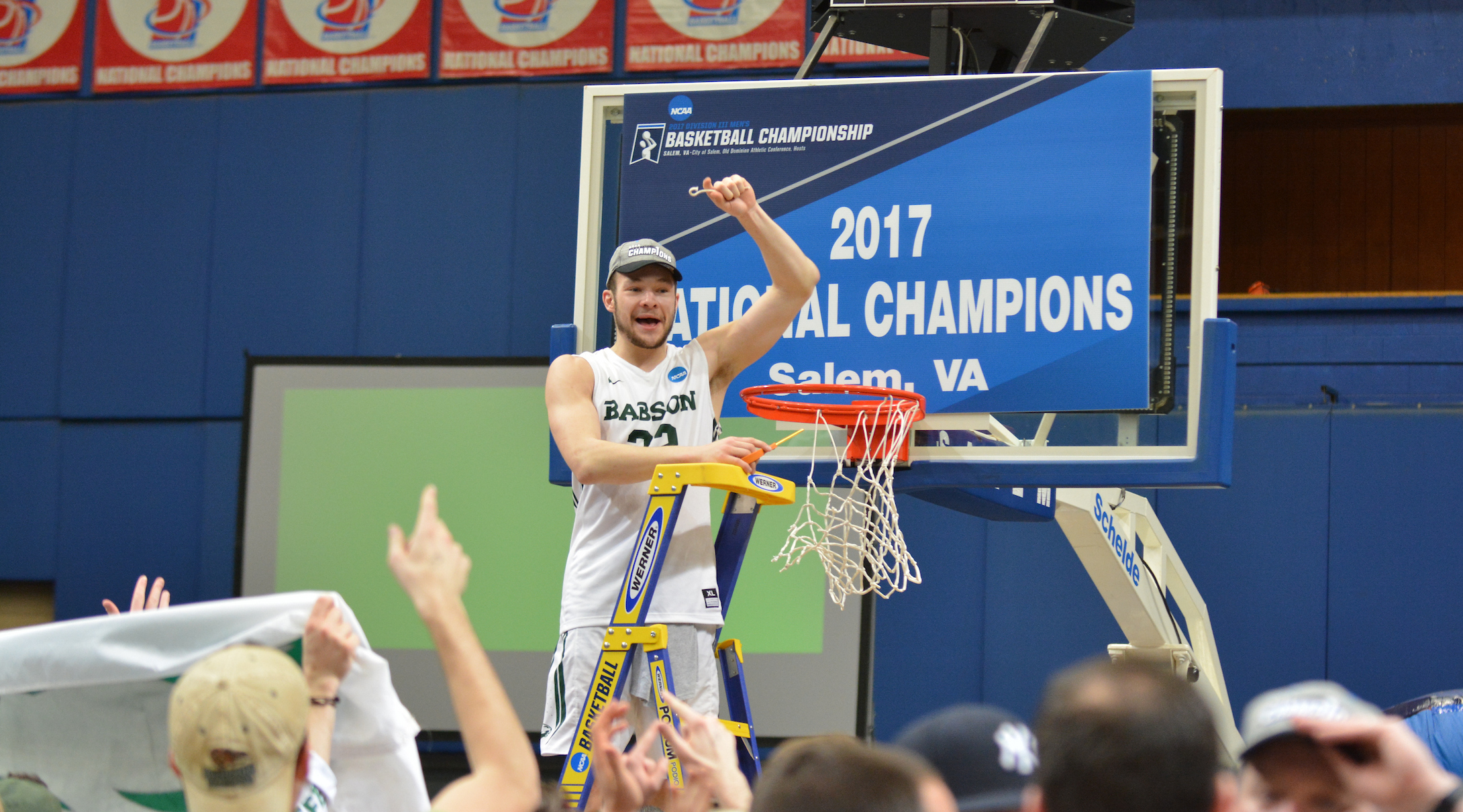
| Joey Flannery celebrates the 2017 national championship shortly after sealing the win with a game-saving shot block. Photo by d3photography.com |

If you were in the Salem Civic Center for the 2017 National Championship game, there’s likely only one thing you remember. If you really think hard, you might recall most of the game as a stellar back and forth contest between two teams playing at the peak of their powers. Babson faced Augustana again, but the roles were reversed. The Vikings had a precocious sophomore class, punching above their weight and Babson was the senior-ladened squad.
Most people, though, don’t remember much before 2:28 to go in the fourth quarter.
Babson had a four-point lead and then nobody could score. Flannery missed two straight threes. Augustana missed three shots of their own. Rice missed the front end of a 1-and-1, then, with just ten seconds left, the Vikings finally hit a deep shot and cut Babson’s lead to one, 79-78.
Quick foul. Joey Flannery at the line. Still shooting 1-and-1… and… he missed. Augustana got the rebound and tossed it ahead to Nolan Ebel, the fastest guy on the court, who split two Babson defenders and headed straight for the rim, a little floater that was 100% going in.
“I remember vividly,” says Brennan. “I see it a lot in my head. We have led for this whole game and we’re going to hand it over right now. He’s got a head of steam and there’s time. I guess Geometry is important, though — the fastest way between two points is a straight line.”
Most players, after missing a shot like Flannery did, would take at least a half second to react, to freeze, to fret, to sulk in the moment; it’s only natural. Joey Flannery did not. As Ebel’s shot is heading up towards the rim, Flannery arrives, out of nowhere, skying over everything to slam the ball off the backboard and force Augustana to foul with one second left.
“[Ebel] had been going right all game. There was a play earlier where he did the same thing and I couldn’t get my right-left takeoff to try and block it. So I kinda had the vibe that he was going to hesitate and go right, get downhill. I went up and got higher than maybe I normally would have and was able to get it off the glass.”
Droney missed yet another front end of a one-and-one, but the Augustana Hail Mary didn’t connect. Joey Flannery grabbed the ball, leapt onto the scorer’s table to celebrate a national title on St. Patrick’s Day, with a lot of well lubricated fans from Boston.
“I was on the scorer’s table,” says Flannery, slightly embarrassed by how it was perceived. “I was yelling to our families and my family and everyone who was a part of it with us, our alums. That was everyone in it together.”
“[The block] summed him up so well,” says Droney. “It’s very symbolic of the way Joe went about everything. Work hard. Make a play. Do the next right thing.”
The block came on the heels of Lebron’s epic NBA Finals chase down and entered Division III lore in the way Michael Jordan’s flu game or the final push-off and game winner have for the rest of the basketball world. Yes, a guy who was very good — better than almost everybody — but a success that came from hard work, relentlessness, and a preternatural ability to make everyone better. Joey Flannery just wins games.
It makes perfect sense that he is the first Small College Basketball inductee from the 2000s. It’s not that he’s the best Division III player of the era (although that can certainly be argued), but that he achieved at the absolute pinnacle of his abilities for his entire college career.
Maybe the “Michael Jordan of Division III” moniker is a little over the top; a scientific comparison might not hold up. But as we get farther and farther from the eras in which they played, it’s the legend that echoes most clearly, above any statistic or evaluation.
Flannery’s legend did not end on that scorer’s table. A Los Angeles Clippers scout, visiting UMass, happened to venture across the street and see Flannery perform at Amherst and saw enough to get him a workout before the 2017-18 season. He’d been battling an injury and didn’t perform at his best, but ended up in Spain, where it became pretty clear his playing days were over.
“I loved a warm, sunny Christmas,” says Flannery. “But without the Christmas tree and my family so far away, I knew it would be a one year deal.”
Even Philadelphia was too far away. After six seasons on staff at Villanova, Flannery returned to Babson, where he serves as associate head coach.
“Joe was on the path to being a big time D-I assistant coach,” says Wright, who got his coaching start at Division III under Mike Neer at Rochester. “But he loves Division III and he wanted to go back to it.”
Flannery approaches coaching with the same fervor and determination he gave to playing, and he’s a true Division III guy, through and through, “I’d be happy to be [at Babson] forever.” While he doesn’t have any eligibility left on the floor, the sky’s the limit for where Babson can go with Flannery on the bench.
“The guys don’t quite know what they have in him yet,” says Brennan, “the ways he can help them.” And after a pause, he adds “They did see him score 24 points in one half of a summer league game, though, so they’re starting to get some idea.”
This October, Babson’s greatest player will be inducted into the Small College Basketball Hall of Fame. For many honorees, that’s the end of the story; for Joey Flannery it’s just another chapter in the legend that continues to be written.